
Immunology & Infectious Disease
Researchers in the IBMS Immunology and Infectious Disease cluster use a range of cross-disciplinary approaches to study the mechanisms of pathogen virulence, the immunological responses required for pathogen control, and the molecular and cellular interactions between host and pathogen. Diseases that affect individuals in low and middle income countries such as tuberculosis, malaria, and leishmaniasis are a major research focus for a number of faculty in the cluster. Other studies address autoimmunity, inflammatory diseases, cancer immunotherapy, and basic immunological mechanisms. Information garnered from the various laboratories has led to research into new vaccines, diagnostics, and drugs. Students in the cluster have the opportunity to use biochemical, molecular and cellular-based approaches, as well as whole-animal based systems to address their various research questions.
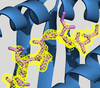
Image: Three dimensional structure of a melanoma vaccine candidate presented by a major histocompatibility complex protein. Courtesy of the laboratory of Brian Baker.
Contact

Jeff Schorey (website>)
Department of Biological Sciences
schorey.1@nd.edu
(574) 631-3734
Participating Faculty
Alvaro Acosta SerranoBiological Sciences |
We study the biology of kinetoplastid parasites and their insect vectors using biochemical, molecular and cellular approaches and develop new tools to prevent transmission of vector-borne pathogens
|
Brian BakerChemistry and Biochemistry |
Structural biology and biophysics of recognition and signaling in immunity, cancer, and antibiotic resistance |
David BooneMicrobiology & Immunology (IUSM-SB) and Biological Sciences (ND) |
Genetics, cancer, and intestinal inflammation |
Francis CastellinoChemistry and Biochemistry |
In vitro and in vivo relationships between hemostasis and inflammation |
Patricia A. ChampionBiological Sciences |
Molecular genetics of mycobacterial protein secretion and pathogenesis |
Patricia L. ClarkChemistry and Biochemistry |
Protein biophysics in living cells |
Ana Lidia Flores-MirelesBiological Sciences |
Molecular, Cellular, and Immunological Analysis of the Pathogenesis of Catheter-associated Infections |
Kasturi HaldarBiological Sciences |
Understanding disease pathology and developing treatments in rare and neglected diseases |
Dana Klatt ShawBiological Sciences |
A spinal cord injury in mammals leads to a lifelong reduction of neural function, while zebrafish are capable of full functional recovery after a spinal cord injury. The goal of our lab is to understand what gives zebrafish this remarkable ability for enhanced regenerative capacity |
Cristian KoepfliBiological Sciences |
Molecular epidemiology of infectious diseases in Africa, Latin America, and the Asia-Pacific |
Laurie LittlepageChemistry and Biochemistry |
Modeling cancer progression in vivo to develop biomarkers and therapies; contributions of the microenvironment to breast and prostate cancers
|
Xin LuBiological Sciences |
Molecular Understanding and Immunotherapy of Metastatic Cancer; Novel Animal Models for Rare Cancers |
Mary Ann McDowellBiological Sciences |
Immunoparasitology |
Christian MelanderChemistry and Biochemistry |
New Approaches for Antibiotic Discovery |
Shahriar MobasheryChemistry and Biochemistry |
Bioorganic and biochemistry of antibiotic resistance and cancer metastasis |
Mariko MorimotoChemistry and Biochemistry |
Developing chemical approaches to discover and target immune-regulating mechanisms, with a particular focus on glycobiology and chemically induced proximity. |
Bernard NahlenBiological Sciences |
Studies of efficacy/effectiveness of tools for control of communicable diseases, interactions between HIV and malaria, malaria prevention |
Pilar Pérez RomeroBiological Sciences |
Characterizing virus-cell interaction to identify viral gene products that play a role in regulating the host immune response for the development of therapeutic and preventive approaches against infection |
Felipe H Santiago-TiradoBiological Sciences |
Cryptococcal cell biology and host interactions important for disease
|
Molly Duman ScheelMedical and Molecular Genetics (IUSM-SB) and Biological Sciences (ND) |
Genetic and comparative analysis of invasive cellular growth; vector mosquito developmental genetics |
Jeff SchoreyBiological Sciences |
Immunology and Cell Biology of Mycobacterium - Host Cell Interactions |
Margaret SchwarzPediatrics (IUSM-SB) and Chemistry and Biochemistry (ND) |
Anti-angiogenic factors in lung and tumor development |
Joshua ShroutCivil & Environmental Engineering & Earth Sciences; Biological Sciences |
Bacterial biofilms, cell-cell signaling, and surface motility |
Herman SintimChemistry and Biochemistry |
Develop cyclic dinucleotide (CDN) probes to illuminate CDN biology, identify small molecule inhibitors of CDN signaling in bacteria with potential use as novel antibacterial agents, identify potential therapeutics that agonize Stimulator of Interferon Genes, STING, (immunotherapies) or antagonize STING (anti-inflammatory compounds); kinase inhibitors involving drug resistance |