
Genomics & Proteomics
Researchers in the IBMS Genomics and Proteomics cluster study the information content of cells: their genomes and the sets of proteins they code for. Ongoing genomic studies range from investigations of genome structure and architecture to comparative genomics of pathogens and model organisms. In proteomics, ongoing studies include comparative analyses of the proteomes of normal and diseased tissues, studies of proteomic changes as a function of cellular differentiation and tissue microenvironment, and development of next-generation proteomic methods. Significant resources exist for high throughput, high volume DNA and protein sequencing and detailed analyses of complex, information-rich biochemical and biological samples. Students in the cluster learn how to identify and quantify changes in gene expression, from the single microRNA level up to global alterations in a proteome.
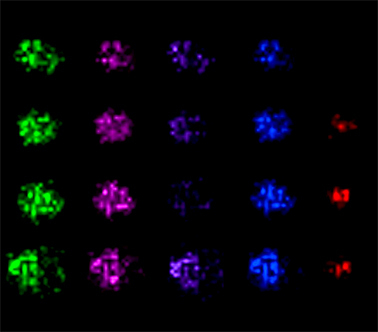
Image: Imaging of protein expression in tumor cell spheroids via MALDI mass spectrometry. Courtesy of the laboratory of Amanda Hummon.
Contact

Britany Morgan (website>)
Department of Chemistry & Bioechemistry
bmorgan3@nd.edu
(574) 631-8333
Participating Faculty
Alvaro Acosta SerranoBiological Sciences |
We study the biology of kinetoplastid parasites and their insect vectors using biochemical, molecular and cellular approaches and develop new tools to prevent transmission of vector-borne pathogens
|
Merlin BrueningChemistry and Biochemistry |
Develop rapid membrane-based protein capture for immunoassays and sample purification and digestion methods for mass spectrometry analyses of proteins and their glycosylation patterns. |
Francis CastellinoChemistry and Biochemistry |
In vitro and in vivo relationships between hemostasis and inflammation |
Matthew ChampionChemistry and Biochemistry |
Primarily interested in developing and exploiting novel approaches to identify and characterize the components of secreted proteins from virulent microorganisms. |
Crislyn D'Souza-SchoreyBiological Sciences |
Signal integration and cancer progression |
Jeffrey FederBiological Sciences |
Ecological and evolutionary dynamics of interactions between disease carrying insects and their human hosts; Chagas, malaria |
Michael FerdigBiological Sciences |
Genetics and genomics of drug resistance and virulence in the malaria parasite |
Ana Lidia Flores-MirelesBiological Sciences |
Molecular, Cellular, and Immunological Analysis of the Pathogenesis of Catheter-associated Infections |
Kasturi HaldarBiological Sciences |
Understanding disease pathology and developing treatments in rare and neglected diseases |
David R. HydeBiological Sciences |
Visual System Development and Dysfunction |
Dana Klatt ShawBiological Sciences |
A spinal cord injury in mammals leads to a lifelong reduction of neural function, while zebrafish are capable of full functional recovery after a spinal cord injury. The goal of our lab is to understand what gives zebrafish this remarkable ability for enhanced regenerative capacity |
Cristian KoepfliBiological Sciences |
Molecular epidemiology of infectious diseases in Africa, Latin America, and the Asia-Pacific |
Laurie LittlepageChemistry and Biochemistry |
Modeling cancer progression in vivo to develop biomarkers and therapies; contributions of the microenvironment to breast and prostate cancers
|
Xin LuBiological Sciences |
Molecular Understanding and Immunotherapy of Metastatic Cancer; Novel Animal Models for Rare Cancers |
Mary Ann McDowellBiological Sciences |
Immunoparasitology |
Brittany MorganChemistry and Biochemistry |
Targeting RNA-binding proteins to understand structure, function, and dynamics |
Michael PfrenderBiological Sciences |
Ecological genomics; adaptation in natural populations; plasticity |
Molly Duman ScheelMedical and Molecular Genetics (IUSM-SB) and Biological Sciences (ND) |
Genetic and comparative analysis of invasive cellular growth; vector mosquito developmental genetics |
Cody J. SmithBiological Sciences |
Development and Regeneration of the Nervous System |
Kevin VaughanBiological Sciences |
Molecular basis of organelle transport |
Pinar ZorlutunaBiological Sciences |
New methodologies to investigate and develop micro and nanoscale approaches to study the cell-cell and cell-matrix interactions to address important health problems such as cancer, heart disease and aging and to engineer bio-inspired systems; tissue engineering, regenerative medicine, cancer biology |