
Cancer Biology
Researchers in the IBMS Cancer Biology cluster study the onset, prevention, detection, and treatment of cancer. The cluster draws from a diverse range of complementary biomedical fields, including molecular and cellular biology, biochemistry, immunology, pharmacology, structural biology, and chemical biology. Areas of particular expertise include oncogenes and growth factors, cell adhesion and metastasis, the tumor microenvironment, the immune response to cancer, and drug design and development. The newly opened Mike and Josie Harper Cancer Research Institute is a focal point for scientists in this interdisciplinary cluster, fostering translation of findings from the laboratory to the clinic. While students in the cluster are trained in a variety of scientific specialties, their studies share the common goal of aiming to understand and eliminate suffering from cancer.
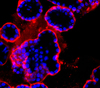
Image: Breast cancer cells visualized by immunofluorescent staining. Courtesy of the laboratory of Zachary Schafer.
Contact

Laurie Littlepage (website>)
Department of Chemistry & Biochemistry
laurie.littlepage@nd.edu
(574) 631-4804
Participating Faculty
Brian BakerChemistry and Biochemistry |
Structural biology and biophysics of recognition and signaling in immunity, cancer, and antibiotic resistance |
Brian BlaggChemistry and Biochemistry |
Mechanisms of protein folding and their contribution to cancer and/or neurodegeneration |
David BooneMicrobiology & Immunology (IUSM-SB) and Biological Sciences (ND) |
Genetics, cancer, and intestinal inflammation |
Francis CastellinoChemistry and Biochemistry |
In vitro and in vivo relationships between hemostasis and inflammation |
Juan Del ValleChemistry and Biochemistry |
Design, chemical synthesis, biological evaluation of modulators of protein-protein interactions, ER stress response inhibitors, non-ribosomal peptide natural products; cancer, neurodegenerative disease, bacterial infections |
Crislyn D'Souza-SchoreyBiological Sciences |
Signal integration and cancer progression |
Kaiyu FuChemistry and Biochemistry |
Integration of nanotechnology, advanced materials, and bioanalytical techniques with automated data acquisition and processing to develop biomedical devices that enable point-of-care diagnostics and improve chronic disease management. |
Bei HuApplied & Computational Mathematics & Statistics |
Mathematical modeling of tumor growth |
Jianneng LiBiological Sciences |
My laboratory focuses on the functions of steroid hormones including their precursors and receptors in prostate cancer as well as related diseases |
Laurie LittlepageChemistry and Biochemistry |
Modeling cancer progression in vivo to develop biomarkers and therapies; contributions of the microenvironment to breast and prostate cancers
|
Xin LuBiological Sciences |
Molecular Understanding and Immunotherapy of Metastatic Cancer; Novel Animal Models for Rare Cancers |
Shahriar MobasheryChemistry and Biochemistry |
Bioorganic and biochemistry of antibiotic resistance and cancer metastasis |
Brittany MorganChemistry and Biochemistry |
Targeting RNA-binding proteins to understand structure, function, and dynamics |
Mariko MorimotoChemistry and Biochemistry |
Developing chemical approaches to discover and target immune-regulating mechanisms, with a particular focus on glycobiology and chemically induced proximity. |
Jenifer ProsperiBiochemistry and Molecular Biology (IUSM-SB) and Biological Sciences (ND) |
Breast cancer biology and chemotherapeutic resistance |
Zachary SchaferBiological Sciences |
Cancer cell biology and metabolism |
Molly Duman ScheelMedical and Molecular Genetics (IUSM-SB) and Biological Sciences (ND) |
Genetic and comparative analysis of invasive cellular growth; vector mosquito developmental genetics |
Margaret SchwarzPediatrics (IUSM-SB) and Chemistry and Biochemistry (ND) |
Anti-angiogenic factors in lung and tumor development |
Herman SintimChemistry and Biochemistry |
Develop cyclic dinucleotide (CDN) probes to illuminate CDN biology, identify small molecule inhibitors of CDN signaling in bacteria with potential use as novel antibacterial agents, identify potential therapeutics that agonize Stimulator of Interferon Genes, STING, (immunotherapies) or antagonize STING (anti-inflammatory compounds); kinase inhibitors involving drug resistance |
Bradley SmithChemistry and Biochemistry |
Biooganic and supramolecular chemistry; development of new reagents for biomedical imaging |
Sharon StackChemistry and Biochemistry |
Proteolysis and adhesion in cancer metastasis |
Kevin VaughanBiological Sciences |
Molecular basis of organelle transport |
Matthew WebberChemistry and Biochemistry |
Engineering improved therapeutics and biomimetic and bio-insprired materials |
Katharine WhiteChemistry and Biochemistry |
Cellular pH dynamics; pH-sensitive mechanisms regulating proteins, pathways, and cancer cell behaviors |
Olaf WiestChemistry and Biochemistry |
Computational drug design |
Jeremiah ZartmanBiological Sciences |
systems biology of organ growth and regeneration; reverse-engineering signaling networks and biophysical mechanisms that regulate cell decisions such as differentiation, proliferation, and apoptosis, as it relates to organogenesis, cancer, and wound healing
|
Pinar ZorlutunaBiological Sciences |
New methodologies to investigate and develop micro and nanoscale approaches to study the cell-cell and cell-matrix interactions to address important health problems such as cancer, heart disease and aging and to engineer bio-inspired systems; tissue engineering, regenerative medicine, cancer biology |